
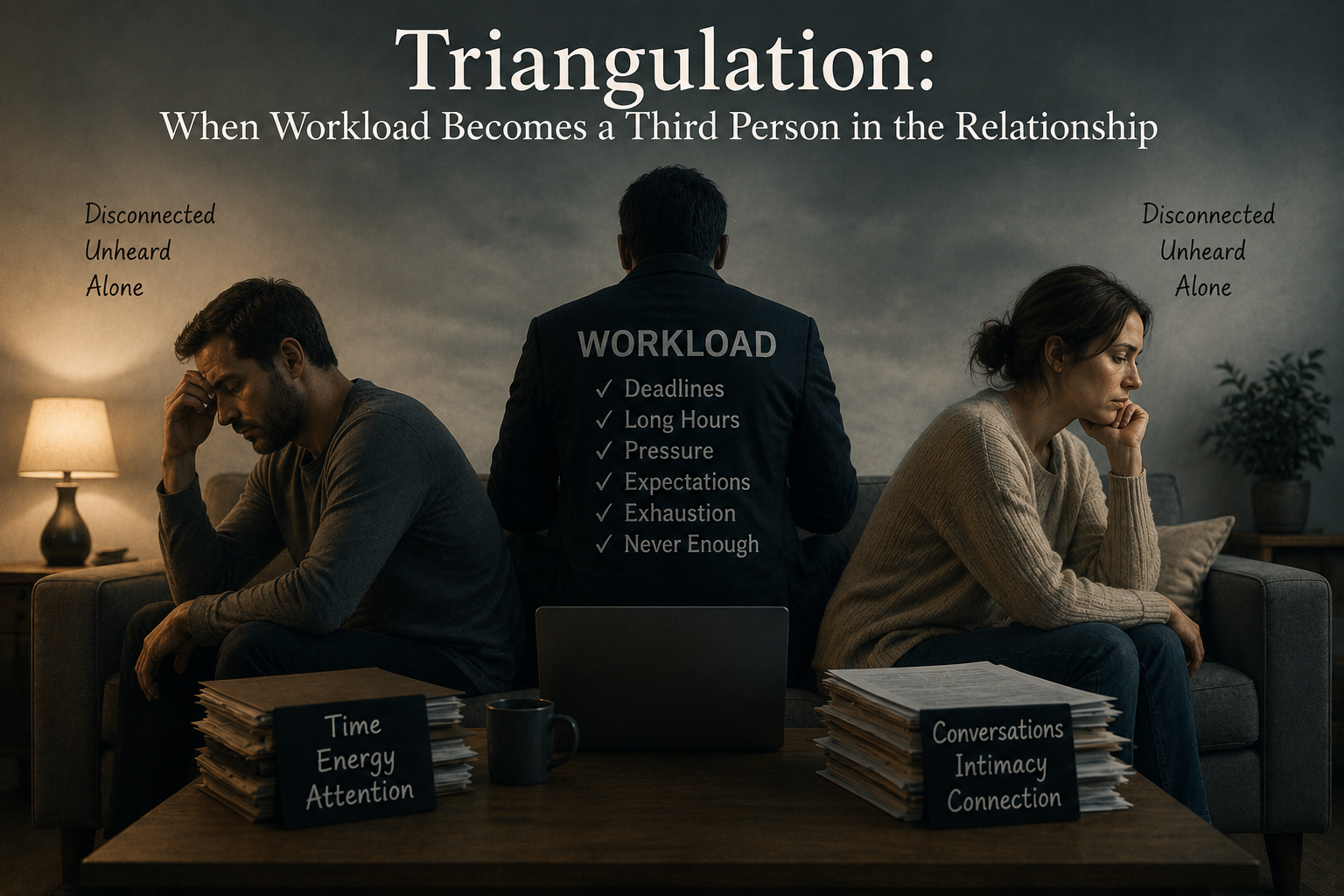
There are times in relationships when the conflict between two people is not entirely about the relationship itself.
A partner may appear distant, irritable, emotionally shut down or constantly distracted. Small conversations become tense. Minor frustrations escalate more quickly than they once did. One partner may begin pursuing reassurance while the other withdraws further. Over time, both people can begin reacting to patterns neither fully understands.
In many relationships, particularly those involving high-pressure occupations, operational stress, long working hours, emotional fatigue or chronic workplace strain, the relationship itself can slowly begin carrying the psychological load of the workplace.
In family systems theory, Murray Bowen described a concept known as triangulation. A triangle forms when tension or anxiety between two people is stabilised by involving a third element. In some relationships, that third element may be another person. In others, it may be work itself.
Workload, stress, organisational pressure, emotional exhaustion or operational hypervigilance can gradually become an unseen third presence within the relationship. Conversations become shaped by fatigue. Emotional availability decreases. Irritability increases. The nervous system remains activated long after work has ended.
Over time, couples may unknowingly begin organising themselves around the stress entering the relationship from outside it.
This is particularly common in professions involving sustained exposure to responsibility, conflict, trauma, uncertainty or high operational demand. First responders, healthcare workers, military personnel, executives, shift workers and people in leadership positions often develop patterns of vigilance, emotional suppression or rapid problem-solving that are highly adaptive at work but can become difficult within intimate relationships.
A partner may experience this not as “work stress,” but as emotional distance, impatience, criticism or disconnection.
They may begin saying things such as:
- “You never switch off.”
- “I feel like you’re not really here.”
- “Everything feels tense lately.”
- “I don’t know how to talk to you anymore.”
- “I feel like I’m walking on eggshells.”
The other partner may feel misunderstood and overwhelmed themselves, believing they are simply trying to cope or keep functioning under pressure.
This can create a reactive cycle where one partner increasingly pursues emotional connection while the other withdraws further in an attempt to regulate stress internally. Eventually, both people become focused on each other’s reactions while the original source of strain remains insufficiently recognised.
From a systems perspective, the relationship has started adapting to external anxiety entering the emotional system.
Importantly, this does not mean the workplace is “to blame” for all relationship difficulties. Relationships are always shaped by multiple factors including attachment history, communication styles, personality, family experiences and broader life stressors. However, workplace pressure can significantly amplify existing relational patterns and lower the emotional flexibility people normally bring into their relationship.
This is one reason many couples report that arguments often seem disproportionate to the actual issue being discussed. The disagreement itself may only be the visible surface expression of accumulated emotional strain sitting underneath the relationship system.
In counselling, helping couples understand these dynamics can reduce blame and increase insight. Instead of viewing one another solely as “the problem,” couples can begin recognising the patterns developing around stress, emotional regulation and nervous system overload.
This often changes the conversation from:
“Which one of us is causing this?”
to:
“What is happening to the relationship system under pressure?”
That shift can be profoundly important.
When couples understand how stress enters and reshapes relational dynamics, they are often better able to recognise reactive cycles earlier, communicate with greater clarity and restore emotional safety within the relationship.
Healthy relationships are not relationships without stress. Rather, they are relationships where both people gradually learn how to recognise pressure before it fully takes over the emotional space between them.
For many couples, workload is not just something occurring outside the home. Over time, it can quietly become a third presence within the relationship itself.
FAQ
What is triangulation in relationships?
Triangulation is a concept from family systems theory where tension between two people becomes stabilised through the involvement of a third element. This may involve another person, but it can also involve stress, work, children, technology or external pressures entering the relationship dynamic.
Can work stress affect a relationship?
Yes. Chronic work stress can affect emotional availability, communication, patience, intimacy and nervous system regulation within relationships. Over time, workplace pressure can contribute to conflict, withdrawal, emotional shutdown or reactive communication patterns.
Why do couples argue more when stressed?
Stress reduces emotional flexibility and increases nervous system reactivity. When people are emotionally overloaded, they are more likely to misinterpret tone, become defensive, withdraw emotionally or react more intensely to relatively small issues.
Can first responder work affect relationships?
Professions involving trauma exposure, operational pressure, shift work and hypervigilance can significantly affect relationship dynamics. Many first responders and their partners experience challenges involving emotional disconnection, stress spillover, irritability and difficulties transitioning from operational environments into home life.
How can counselling help with stress-related relationship problems?
Couples counselling can help partners recognise reactive cycles, improve communication, understand emotional triggers and rebuild emotional safety. Counselling may also help couples better understand how external pressures are influencing the relationship system itself.
References
Bowen, M. (1978). Family Therapy in Clinical Practice. Jason Aronson.
Kerr, M. E., & Bowen, M. (1988). Family Evaluation. W.W. Norton.
Titelman, P. (2014). Clinical Applications of Bowen Family Systems Theory. Routledge.
Johnson, S. M. (2019). Attachment Theory in Practice: Emotionally Focused Therapy (EFT) with Individuals, Couples, and Families. Guilford Press.
Siegel, D. J. (2020). The Developing Mind: How Relationships and the Brain Interact to Shape Who We Are (3rd ed.). Guilford Press.
For relationship counselling and support with stress, emotional regulation and communication patterns, visit Blue Healers Counselling