
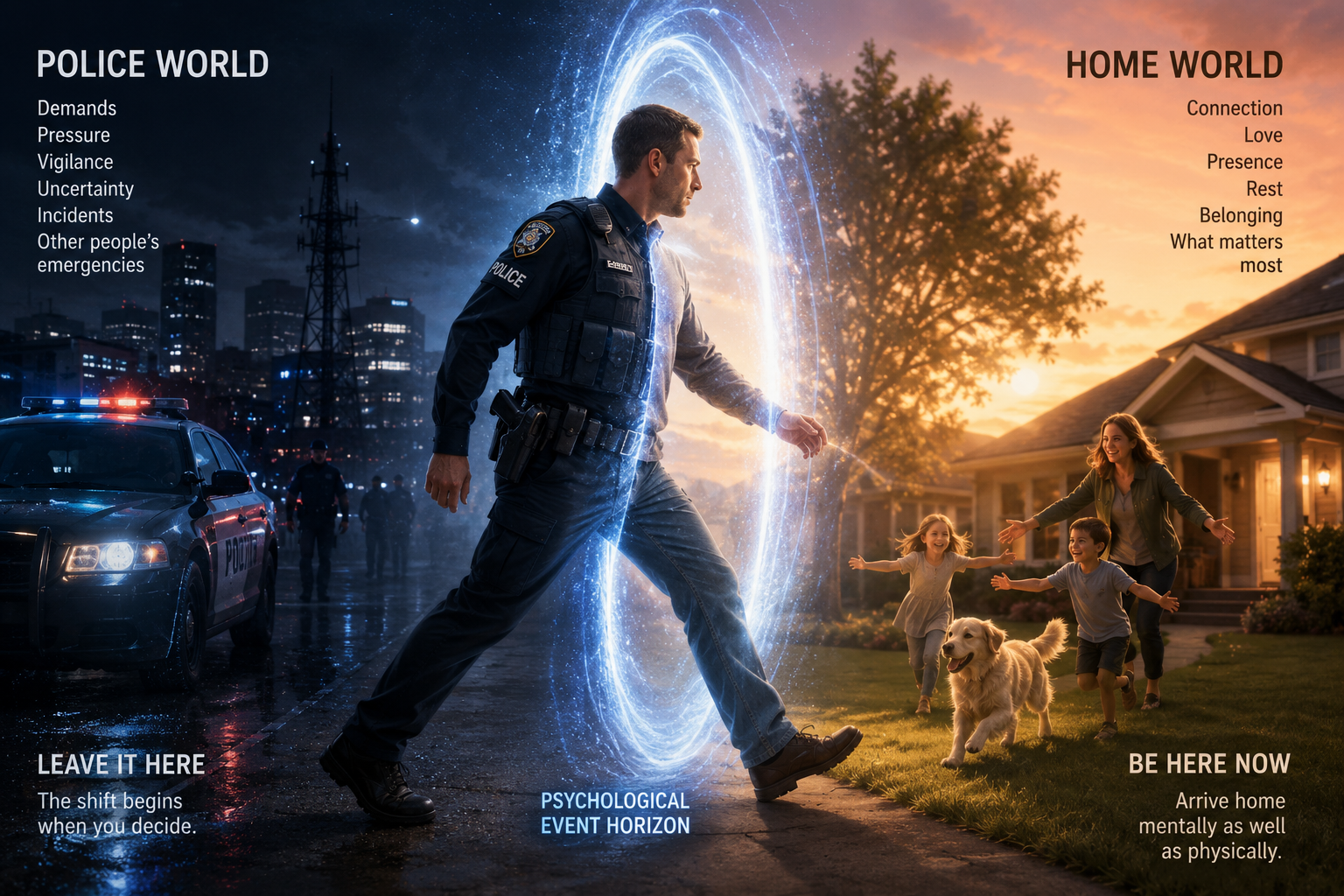
Every day we move between different worlds.
We leave work and head home. We leave home and head to work. We move between being a police officer, a nurse, a teacher, a tradesperson, a leader, a parent, a partner or simply ourselves.
Although these journeys may only take twenty or thirty minutes, the psychological transition is often much longer.
Many people arrive home physically, but mentally they are still at work. Their thoughts remain on unfinished tasks, difficult conversations, tomorrow’s workload or an incident that continues to replay in their mind. Their body may be sitting on the lounge, but their attention and nervous system remain engaged with the demands of the workplace.
The opposite is equally true. Stress at home can follow us into the workplace, reducing our concentration, patience and decision-making before the day has even begun.
Research in cognitive psychology suggests that our brains naturally organise our experiences into distinct events as we move between different contexts. Rather than experiencing life as one continuous stream, we mentally segment it into meaningful episodes. Even something as simple as walking through a doorway can trigger our brain to update its focus, a phenomenon sometimes referred to as the “doorway effect”.
Inspired by this understanding, I have found it helpful to think about creating what I call a Psychological Event Horizon.
The Psychological Event Horizon is not a formal therapeutic technique. It is a practical metaphor that uses a consistent physical landmark as the beginning of an intentional psychological transition between one important life role and another.
Imagine selecting one consistent point during your daily commute. It may be a bridge, a familiar intersection, a roundabout or the turn into your street. This becomes your Psychological Event Horizon—the place where you consciously begin leaving one psychological world and preparing yourself for the next.
As you approach this point on your journey home, choose three words that represent how you want to arrive.
Perhaps your words are:
Peace. Calm. Content.
You may also choose a colour that symbolises this state. For some people it may be the warm orange of a fireplace. For others it may be the calming blue of still water or an open sky.
As you pass your Psychological Event Horizon, your attention deliberately shifts away from work. Rather than replaying the events of the day, you begin preparing yourself for the role that awaits you at home.
By the time you walk through your front door, you have intentionally become consciously competent at being present with the people who matter most.
The same process works in reverse.
As you leave home, the same Psychological Event Horizon becomes the place where you prepare yourself for your professional responsibilities.
Your words may become:
Performance. Excellence. Consistency.
Perhaps your chosen colour is green, representing growth, purpose, professionalism or readiness.
By the time you arrive at work, you have intentionally shifted your attention towards the responsibilities that deserve your focus.
This practice is not about pretending life is easy or ignoring the realities of stress. There will always be days when work follows us home or home follows us to work. We are human.
The difference is that we begin practising intentional transitions rather than unconsciously carrying one psychological world into another.
When we fail to transition between roles, overwhelm can accumulate.
As our emotional load increases, our window of tolerance often narrows. We become less able to think flexibly, regulate our emotions and respond thoughtfully to the situations in front of us. Instead, we become more likely to react automatically as our nervous system prioritises perceived threat over reflection, curiosity and connection.
This is often where we notice anger emerging more quickly than usual. Frustration becomes easier to trigger. Patience shortens. We withdraw from those around us, avoid conversations, isolate ourselves or rely on alcohol or other coping strategies simply to quieten an overwhelmed mind.
These behaviours are rarely signs of personal weakness.
More often, they are signs that we have remained psychologically connected to one world while physically entering another.
Creating a Psychological Event Horizon will not eliminate stress, nor will it prevent difficult days. What it can provide is a simple, repeatable practice that encourages us to intentionally reset our attention, regulate our nervous system and become more present in the role we are about to enter.
Perhaps the goal is not simply arriving somewhere physically.
Perhaps the goal is learning to arrive there psychologically as well.
At Blue Healers Counselling, we work with people experiencing stress, anxiety, trauma, relationship difficulties and major life challenges. Sometimes meaningful change does not begin with dramatic life decisions. Sometimes it begins with a simple, intentional practice repeated every day until it becomes part of who we are.
References
Clear, J. (2018). Atomic habits: Tiny changes, remarkable results. Avery.
Hayes, S. C., Strosahl, K. D., & Wilson, K. G. (2016). Acceptance and commitment therapy: The process and practice of mindful change (2nd ed.). Guilford Press.
Harris, R. (2022). The happiness trap (2nd ed.). Exisle Publishing.
Porges, S. W. (2011). The polyvagal theory: Neurophysiological foundations of emotions, attachment, communication, and self-regulation. W. W. Norton & Company.
Radvansky, G. A., & Zacks, J. M. (2017). Event cognition. Oxford University Press.
Siegel, D. J. (2020). The developing mind: How relationships and the brain interact to shape who we are (3rd ed.). Guilford Press.
van der Kolk, B. A. (2014). The body keeps the score: Brain, mind, and body in the healing of trauma. Viking.